Wednesday, 15 July 2015

Everyday Design: Simple Landscaping Tips for Your Home

Everyday Design: Simple Landscaping Tips for Your Home: Designing your landscape is a sure way of transforming your home into a serene environment ideal for human enjoyment and experience.  Creat...

Monday, 13 July 2015

Everyday Design: About Rock Gardening

Everyday Design: About Rock Gardening: For most homeowners, the idea of including a nicely crafted garden is quite evident as it complements the building and creates such a...

Everyday Design: Selecting Trees for Your Landscape-Tips

Everyday Design: Selecting Trees for Your Landscape: On any landscape, trees offer a lifetime of fulfilling functions ranging from beauty, air purification, shade, creating spaces among othe...

Friday, 10 July 2015

Everyday Design: Redefining outdoor architecture

Everyday Design: Redefining outdoor architecture: In recent developments, there is the urge to include a good landscape design to complement the  architecture owing to the fact that the o...

Monday, 6 July 2015

BEAUTIFUL HOMES- WATER GARDENS; Ponds- Tips and Designs

What comes into your mind when you think of a water garden? A garden full of different plants in water? You might just be right. A water garden is actually a blend of different plants, water and possibly with the inclusion of aquatic animals. But this blending has to be done right so as to ensure peaceful co-existence. Water gardens can come in many forms; ponds, streams, rain gardens, and even pools.

Let's talk about backyard ponds today. Many view a pond as just a natural pool of water in a place. But can you really design a pond? Or can you have a pond at the backyard of your house?
That is why i am here and i am going to to show you how.


Tips On Jaw-Dropping Backyard Ponds
What do you consider when creating a backyard pond? Try to imagine beyond just water and plants.
You can instead make the pond user friendly and hence bring some live to your backyard.


Blend the elements well
By the elements, i mean the water, plants
rocks, and any other aquatic life. Do not
forget that water is the conspicuous element
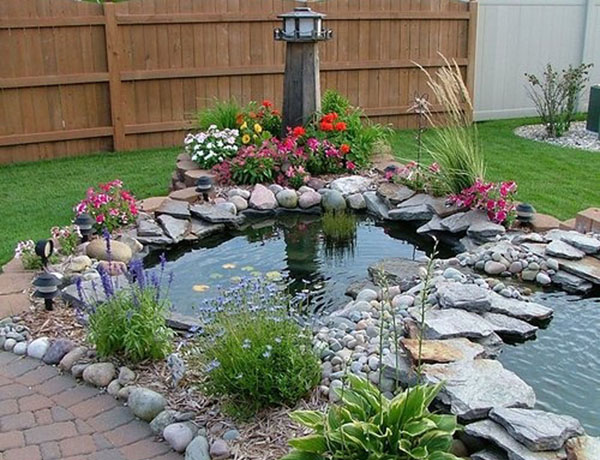
here. Try to include rocks of different
sizes to create some hierarchy. In most cases
rocks should surround the water,i.e act as the
boundary to the pond. Patches of plant species
can be introduced into the water as well as around the rocks as shown.
rocks can also be placed beneath the water
to form the base-small sized for this case.


Make the pond alive


koi fish pond
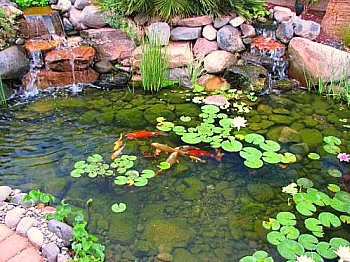
How can you do this? you can introduce some aquatic animals like fish- koi fish- is a good
example of ornamental fish. You can make
your water mobile by introducing a pumping
mechanism. The water source to the pond can
be inform of a fountain. Mobile water ensures
good purification of the water.
pond with seating deck
Most importantly, introducing some seating
place for viewing can really make your pond
more alive. Seating spaces are very welcoming
and hence the pond is usable.
You can also learn how to make your own
koi fish backyard pond.


Light the pond well
                                                                                 
                                                                         
 A well lit pond makes an audience at night,
You can light your pond in different ways.
You can do underwater lighting, overwater lighting;
but the best way is to mix the two.
Underwater lighting will assist in a clear
night vision of the fish at night. The
light colour should be bold enough.

Friday, 3 July 2015

OPEN OUTDOOR FURNITURE AND STRUCTURES-Pergolas, Gazebos, Trellis- TIPS

Have you ever come out of your house on a sunny hot day, you feel like getting some nice cool fresh air but all you see is an extension of grass with nowhere to seat?? Well, that always kills the mood but i am going to unravel that for you.
There are simple outdoor furniture and structures which can make your compound look warm and welcoming. If well implemented in the compound, you cannot regret! Let's find out what i'm talking about here.

PERGOLA

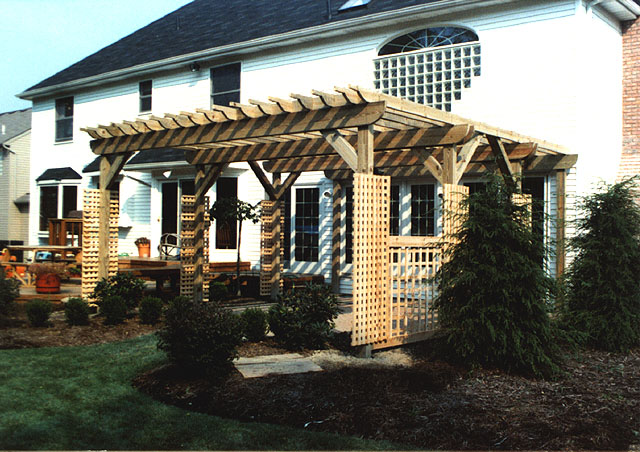
It is a structure that won't provide shelter from
pergola @ the front-yard
wind or rain, and is only marginally better
when it comes to the midday sun. So, why build it? Because in the absence of walls and a roof, it defines an outdoor space without constraining it. It's a unique architectural blend that places you both inside and out at the same time. Do you wish to construct one in your home?Read more to get yours.

There are different types of pergola designs which suites different types of homes. You
just need to be flexible when choosing.


GAZEBO
                                                                                       
Similar to a pergola, it is an open outdoor
structure only that it does not allow rain inside
it. In short, they are roofed and open on all sides
and they can be free standing or attached to
a garden wall.
They can be constructed at your home level
or can be readily bought and just placed in
your home landscape.

Gazebos also take different shapes and designs
depending on its location and functions.
If you want a nice outdoor chilling spot, dream about a gazebo.


TRELLIS

This structure is partially like a pergola, only that
trellis forming entrance
forms a path way as opposed to a seating place.
Even though, seats can be places on the edges.
It can form the perfect entry to your house main
door.
Climbing plants can be made to grow on them
hence acting as support and simultaneously, the plants beautify the trellis.
There are different types of trellis commencing from archs, flowers, wedding and metal trellis.
The occasion rules the type!


Monday, 29 June 2015

COMMON MISTAKES THAT (ALMOST) EVERYONE MAKES IN INTERIOR DESIGN- TIPS & REMEDIES


grey living room


It happens to everyone— you are shopping and see the perfect home decor accessory. Immediately you think, Oh! this will look perfect in my TV room!
Of course, you give in to the impulse buy and excitedly bring home your new-found treasure- only to discover that what looked liked the ideal accessory looks hideous when put in place, and you are left saying, What was I thinking? Where did I go wrong?

What most of us don’t understand is that interior design takes a very keen and knowledgeable eye. We may be out shopping and see something we love, but that doesn’t necessarily mean that it will look perfect in our home. For one fact, our homes are not designed the same way as those beautiful shopping malls. Interior designers understand how color, lighting, room size, scale, and placement all affect how items look in a room and dictates whether they will make or 
break a room design.

There are a lot of common mistakes that almost everyone makes when designing their interiors. Here we look at the 10 most common mistakes and how to avoid making them:

1. Scale In Interior Design


We love how Linda Floyd explains scale and proportion in design, she says, “When you enter into a room, it should be like a city scape…a combination of different heights. You never want everything in a room to be a the same level or the same size. Accomplish this with different heights/sizes in your furnishings, art placement and window treatments.”

Scale is the number one mistake that almost everyone makes when it comes to interior design. This is probably the case because it takes a talented eye to decorate a room with impeccable scale.  Some people put too many small things in a room, thereby cluttering the room and not giving the eye a place to land. A feel of inferiority! You know!

While others put too many large, bulky items in one room, making it look stuffed and small. The secret to proper scale is a mixture of different shapes, heights and sizes.  If there is only one thing that you hire an interior designer for, it is help with proportion and scale.  With the right scale your room is well on its way towards a successful design.


contemporary home
well proportioned room


2. Shop Around And Budget Before Buying

We are all prone to impulse buys. It’s not to say that you shouldn’t buy something that you fall immediately in love with, but maybe just keep the receipt in case it doesn’t work the way you had originally thought.
Before heading to the furniture showroom, it’s best to have a plan and a budget well-established. First, your rooms need to be measured. The furniture placement and size need be planned properly. Luckily, there are a lot of online room arrangement tools that are free and easy to use.
Go into a showroom with a plan in place, helping you know what you want and making sure you stick within your budget. Buyers remorse is an awful feeling, so plan first and shop later.


3. Ask For Help And Interior Design Advice

Even the most skilled designers make mistakes. It can be difficult to spot our mistakes when we have been muddling over the same room design for months-sometimes a room needs a fresh set of eyes to spot the problems.
Ask a friend for an honest opinion on color choice, fabrics, or room arrangement. If it is feasible, hire an interior designer for guidance-you don’t have to hire one for an entire design project, as there are plenty of designers who charge by the hour. Interior designers are full of clever design tips and tricks that can transform your home.
If you disagree with the second opinion, then get a third. Listening to advice, doesn’t mean we have to take it-your home design is uniquely yours and if you love it, then that’s all that really matters, right?


modern kitchen


4. Arrangement Of Accessories And Collections

well arranged accessories 

We all have them—collections.  Somehow it started with one little ceramic bird and now you have a collection of birds in various shapes sizes and colors that you have amassed over the years. What is the proper way to display a collection such as this?

Well, let’s start with the improper way, and the mistake that most of us make— scattering pieces of the collection throughout your home. One little bird may tweet from a fireplace mantle, while another little bird somehow flew all the way over to perch on the coffee table.

No matter what the accessory is, it is best to display them in arrangements and groupings. There are some steadfast rules to arranging items into groups—called the rule of three.  So, gather what you love into groupings and display them proudly and properly.


5. Hanging Art

You can literally turn any wall of your home into your own personal art gallery. Everyone should display some form of art in their home-whether it is a rare oil painting or a cherished drawing from your child’s pre-school days. The road block that most encounter is how to properly hang art.

The best way to ensure there are no mistakes, and nasty nail holes to fill, is to trace and cut-out the frames outline on paper. Simply tape the paper cut-outs onto your wall, trying numerous placement options until you have the desired outcome.

Have fun with your arrangements, playing with size, color, and texture, remembering to avoid the number one mistake that most people make-scale (see number 1 above).

art wall red
well hanged arts


6. Buy Fabrics And Textiles First

fabrics upholstery
A common mistake that most of us are guilty of-painting first. Put that paint brush down! First, you need to pick out the rooms fabrics and main textiles, such as rugs and curtains.

Why is this? Because it is simply much easier to find fabrics that we love and then pick out paint to match. While it is much harder to find a fabric that we love, that also just so happens to match the paint we have already put on our walls.

So, with budget and room size in mind, go for a shopping excursion. Look through samples of fabrics, rugs, pillows etc… Find what you love and then once you are happy with your design choices, pick out a paint shade or shades from the chosen textiles. Now you can pick up the paint brush.


7. Add a Focal Point

Every room needs a focal point-it offers a place for the eye to rest and assigns a room with a function (Note: Larger rooms can have more than one focal point). This is a very common mistake-forgetting to give each room a purpose or point to focus on.

Some rooms are simple-in a TV room the focal point usually ends up being the TV and the unit it is placed on, while all the other main objects in the room (i.e. couches/chairs) are focused and pointing towards the TV.

Other rooms are a bit more difficult, such as sitting rooms or dens. Don’t just scatter furnishings about the room-first, find a focus or purpose for the room, and then place the furnishings around that focal point. For example a fireplace, a gaming table, a large painting, or even a coffee table that encourages guests to sit and converse.
art hanging focal point
photo as focal point

8. Show Your Personality

Your home should speak to who you are; it should be like a personal memoir of your trips, your loves, your life. There is nothing worse than walking into someones home to be greeted by beige walls, brown furniture and one mass-produced print on the wall, pretending to be art.

The above-mentioned room just screams BORING! and we know our readers are far from boring. So, don’t be shy when it comes to your home decor.

Bring in all the things you love, making your home a unique oasis that welcomes you at the end of a hard day, and also tells an intriguing story to your visitors.
Go make your home happen deary.
wood beam fireplace

Sunday, 28 June 2015

Jaw Dropping Water Garden Landscaping Designs Landscaping Ideas